Google

Google Modernizes US Mobile Search Results With Continuous Scrolling (techcrunch.com) 25

Google has announced that it's changing the way search works on mobile devices, initially in the U.S. From a report: Now, when you reach the bottom of a set of search results on your phone, you won't have to tap to go to the next page. Instead, the next set of results will automatically load so you can continuously scroll down to see more information. The change will roll out on the mobile web and will be supported on the Google mobile app for both iOS and Android in the U.S. for most English-language searches for the time being. Because it's a staggered release, you may initially encounter some results which scroll and others that do not.
Google

Google Search's Next Phase: Context is King (theverge.com) 30

At its Search On event today, Google introduced several new features that, taken together, are its strongest attempts yet to get people to do more than type a few words into a search box. From a report: By leveraging its new Multitask Unified Model (MUM) machine learning technology in small ways, the company hopes to kick off a virtuous cycle: it will provide more detail and context-rich answers, and in return it hopes users will ask more detailed and context-rich questions. The end result, the company hopes, will be a richer and deeper search experience. Google SVP Prabhakar Raghavan oversees search alongside Assistant, ads, and other products. He likes to say -- and repeated in an interview this past Sunday -- that "search is not a solved problem." That may be true, but the problems he and his team are trying to solve now have less to do with wrangling the web and more to do with adding context to what they find there.

For its part, Google is going to begin flexing its ability to recognize constellations of related topics using machine learning and present them to you in an organized way. A coming redesign to Google search will begin showing "Things to know" boxes that send you off to different subtopics. When there's a section of a video that's relevant to the general topic -- even when the video as a whole is not -- it will send you there. Shopping results will begin to show inventory available in nearby stores, and even clothing in different styles associated with your search. For your part, Google is offering new ways to search that go beyond the text box. It's making an aggressive push to get its image recognition software Google Lens into more places. It will be built into the Google app on iOS and also the Chrome web browser on desktops. And with MUM, Google is hoping to get users to do more than just identify flowers or landmarks, but instead use Lens directly to ask questions and shop.

Google

Google Tells Judges It's So Popular It's Bing's Top Search Term (bloomberg.com) 75

Google is so successful that it's the most searched for term on Microsoft's Bing search engine, the company's lawyer told a European Union court on Tuesday. From a report: "We have submitted evidence showing that the most common search query on Bing is by far Google," Alfonso Lamadrid, a lawyer for the Alphabet unit, said at the EU's General Court in Luxembourg. The tech giant has asked EU judges to overturn a record $5 billion fine and strike down a 2018 antitrust order that said Google unfairly pushed its search app on mobile phones running its Android software.
Google

Google Seeks Search Deals For TikTok and Instagram Videos (theinformation.com) 10

An anonymous reader shares a report: If you've ever tried searching on Google for one of those TikTok or Instagram videos all your friends are gushing about -- such as sea shanties or the Renegade dance -- you'll notice something. The videos don't show up. Google is trying to fix that -- but there's no guarantee its efforts will succeed. Google executives have been quietly negotiating with their counterparts at the video apps' parent companies, ByteDance for TikTok and Facebook for Instagram, to get the data it needs to index and rank videos, according to three people who were briefed about the discussions. Right now, the best results users typically see when they search are previews of videos from Google-owned YouTube, which at times hosts lower-quality copies or ripoffs of TikTok and Instagram videos. The talks show how Google is trying to keep its search engine relevant with more users as it faces new competition and regulatory threats.
Google

Google To Pay Apple $15 Billion To Remain Default Safari Search Engine In 2021 (9to5mac.com) 74

It's long been known that Google pays Apple a hefty sum every year to ensure that it remains the default search engine on iPhone, iPad, and Mac. Now, a new report from analysts at Bernstein suggests that the payment from Google to Apple may reach $15 billion in 2021, up from $10 billion in 2020. 9to5Mac reports: In the investor note, seen by Ped30, Bernstein analysts are estimating that Google's payment to Apple will increase to $15 billion in 2021, and to between $18 billion and $20 billion in 2022. The data is based on "disclosures in Apple's public filings as well as a bottom-up analysis of Google's TAC (traffic acquisition costs) payments." Bernstein analyst Toni Sacconaghi says that Google is likely "paying to ensure Microsoft doesn't outbid it." The analysts outline two potential risks for the Google payment to Apple, including regulatory risk and Google simply deciding the deal is no longer worth it:

In an interview earlier this year, Apple's senior director of global privacy Jane Horvath offered reasoning for the deal, despite privacy concerns: "Right now, Google is the most popular search engine. We do support Google but we also have built-in support for DuckDuckGo, and we recently also rolled out support for Ecosia."

Google

Google Launches Interactive 3D Periodic Table To Teach Chemistry (somagnews.com) 74

Google has launched an interactive and 3D periodic table of chemical elements to help students learn chemistry. Somag News reports: The new functionality is being integrated into the Google Nest Hub device to encourage chemistry students, but it can now be accessed from any desktop or mobile phone via this link. As there are a multitude of periodic table models available on the internet, Google took care to make yours different, offering some extra features. In Google's interactive periodic table, in addition to searching everything that is known about any chemical element, such as atomic mass and melting point, it will be possible to observe the number of electrons in the last layer rotating around the atomic nucleus through a 3D rendering. Also on display are some trivia like "Lithium is a metal, but it's so soft it can be cut with a knife."

The periodic table is coming in a bundle of Google Assistant updates designed to make family tasks easier, including creating reminders for the Family Bell. This feature, currently only available on smart screens and speakers, will reach the screens of all Android devices in a few weeks.

Google

Google is Starting To Tell You How It Found Search Results (reuters.com) 24

Alphabet's Google will now show its search engine users more information about why it found the results they are shown, the company said on Thursday. From a report: It said people googling queries will now be able to click into details such as how their result matched certain search terms, in order to better decide if the information is relevant.
Google

A New Tool Shows How Google Results Vary Around the World (wired.com) 24

Search Atlas makes it easy to see how Google offers different responses to the same query on versions of its search engine offered in different parts of the world. From a report: The research project reveals how Google's service can reflect or amplify cultural differences or government preferences -- such as whether Beijing's Tiananmen Square should be seen first as a sunny tourist attraction or the site of a lethal military crackdown on protesters. Divergent results like that show how the idea of search engines as neutral is a myth, says Rodrigo Ochigame, a PhD student in science, technology, and society at MIT and cocreator of Search Atlas. "Any attempt to quantify relevance necessarily encodes moral and political priorities," Ochigame says. Ochigame built Search Atlas with Katherine Ye, a computer science PhD student at Carnegie Mellon University and a research fellow at the nonprofit Center for Arts, Design, and Social Research.

Just like Google's homepage, the main feature of Search Atlas is a blank box. But instead of returning a single column of results, the site displays three lists of links, from different geographic versions of Google Search selected from the more than 100 the company offers. Search Atlas automatically translates a query to the default languages of each localized edition using Google Translate. Ochigame and Ye say the design reveals "information borders" created by the way Google's search technology ranks web pages, presenting different slices of reality to people in different locations or using different languages.

Google

Inside Neeva, the Ad-Free, Privacy-First Search Engine From ex-Googlers (fastcompany.com) 70

Sridhar Ramaswamy and Vivek Raghunathan helped turn Google into an ad giant. Now they're starting over with a service whose only customers are its users. From a report: A new search engine? One that people have to pay to use? At first blush, it may seem like a textbook example of a startup idea destined never to get anywhere. By definition, any new search engine competes with Google, whose 90 percent-plus market share leaves little oxygen for other players. And we've been accustomed to getting our search for free since well before there was a Google -- which might make paying for it sound like being expected to purchase a phone book. But Neeva is indeed a new search engine, officially launching today, that carries a subscription fee.

Though it's extremely similar to Google in many respects -- with a few twists of its own -- it dumps the web giant's venerable ad-based business model in the interest of avoiding distractions, privacy quandaries, and other compromises. It's free for three months -- long enough for users to grow accustomed to it without obligation -- and $4.95 a month thereafter. Apps for iPhones and iPads, and browser extensions for Chrome, Firefox, Safari, Edge, and Brave, are part of the deal. Neeva may have a certain whiff of improbability about it, but its cofounders, Sridhar Ramaswamy and Vivek Raghunathan, are the furthest thing from naifs. Two long-time Google executives with more than a quarter-century of experience at the web giant between them, they have an insider's understanding of how it operates. Moreover, about 30 percent of the roughly 60-person staff they've assembled at Neeva consists of ex-Googlers, including Hall-of-Famers such as Udi Manber (a former head of Google search) and Darin Fisher (one of the inventors of Chrome). They've also secured $77.5 million in funding, including investments from venture-capital titans Greylock and Sequoia.

Google

Google Starts Warning Users If Search Results Are Likely To Be Poor (theguardian.com) 57

Google has started warning users when they search for a topic that is likely to have poor results, as part of its effort to tackle "data voids" on the search engine. From a report: The new warning was spotted by Renee DiResta, an academic who studies misinformation at Stanford University. "It looks like these results are changing quickly," Google will now caution users. "If this topic is new, it can sometimes take time for results to be added by reliable sources. First time I've seen this response from Google Search," DiResta said. "Positive step to communicating that something is newsy/breaking (my search was for a breaking culture war story), and highlighting that facts are not all known or consensus on what happened is still being formed."

While social media is regularly linked with misinformation, researchers have long cautioned that search engines can be powerful tools for spreading falsehoods. Data voids, search engine queries that have little to no results, can often lead to fringe claims being given undue prominence -- a particular concern for breaking news. In a blogpost, Danny Sullivan, public liaison for search at Google, said: "We've trained our systems to detect when a topic is rapidly evolving and a range of sources hasn't yet weighed in. We'll now show a notice indicating that it may be best to check back later when more information from a wider range of sources might be available."

Privacy

Google Gets a New Rival as Brave Search Opens To the Public (cnet.com) 60

Brave, the maker of a popular ad blocking browser, opened on Tuesday a public beta of its privacy-focused search engine, a first step in creating a product that could compete with market titan Google. From a report: Unlike other new search engines, which generally repackage results from Google and Microsoft's Bing, Brave is building an independent index of the web. (Brave Search will rely on Bing in some areas, like images, where its own results aren't yet good enough.) Initially, Brave Search won't show ads -- the chief way that Google monetizes its search results. Later, it'll offer free, ad-supported search and a paid option with no ads.
AI

Google's Next AI Move: Teaching Foreign Languages (theinformation.com) 24

An anonymous reader shares a report: Google CEO Sundar Pichai last month previewed an artificial intelligence model that he said would enable people to have open-ended conversations with technology. But current and former employees who have worked with the language model say enabling coherent, free-flowing and accurate dialogue between humans and technology remains a tall order. As a result, Google is taking a more incremental step in conversational AI by preparing to teach foreign languages through Google Search [Editor's note: the link may be paywalled; alternative source], according to people involved in the work. The project, referred to internally as Tivoli, grew out of its Google Research unit and is likely to be rolled out later this year. It will initially work over text, and the exact look and feel of the instruction couldn't be learned.

Googlers are also discussing ways to eventually add the functionality to its voice assistant and YouTube product lines. In YouTube, for example, it could generate language quizzes where viewers record themselves after watching a video and the AI provides an assessment of how they performed. A Google spokesperson did not have a comment. Teaching foreign languages allows Google to move more fluid, conversational AI beyond silly exchanges to a practical-use but low-stakes case, the people said. Using the wrong tense or phrase would be unlikely to cause serious harm to users. AI researchers have for decades worked to foster dialogue between computers and humans that feels real, picks up the nuance of how people communicate and simplifies tasks. Such aspirational technology has been featured in movies like "Her" in which a man communicates with -- and falls in love with -- a virtual assistant.

Google

Google Seeks To Break Vicious Cycle of Online Slander (nytimes.com) 76

Google is changing its algorithm as part of a major shift in how Google polices harmful content. From a report: For many years, the vicious cycle has spun: Websites solicit lurid, unverified complaints about supposed cheaters, sexual predators, deadbeats and scammers. People slander their enemies. The anonymous posts appear high in Google results for the names of victims. Then the websites charge the victims thousands of dollars to take the posts down. This circle of slander has been lucrative for the websites and associated middlemen -- and devastating for victims.

Now Google is trying to break the loop. The company plans to change its search algorithm to prevent websites, which operate under domains like BadGirlReport.date and PredatorsAlert.us, from appearing in the list of results when someone searches for a person's name. Google also recently created a new concept it calls "known victims." When people report to the company that they have been attacked on sites that charge to remove posts, Google will automatically suppress similar content when their names are searched for. "Known victims" also includes people whose nude photos have been published online without their consent, allowing them to request suppression of explicit results for their names. The changes -- some already made by Google and others planned for the coming months -- are a response to recent New York Times articles documenting how the slander industry preys on victims with Google's unwitting help.

Google

Google Adds Feature To Zap Recent Search History in Privacy Push (bloomberg.com) 32

Ever wish you could delete the last thing you searched for on Google? Now Google will let you. From a report: Google announced the new feature Tuesday during its I/O software conference, part of a package of privacy controls the Alphabet company is pushing out to appease consumers and regulators. Users now can tap on a tab inside their Google accounts to remove the last fifteen minutes of search history. The company has offered a feature to clear search histories, but people have found that data useful for tools like Maps or been unaware of the ability to delete it. The new ways to give people more privacy controls come after years of scrutiny on the search giant's behavior. "We never sell your personal information to anyone," Jen Fitzpatrick, a Google senior vice president, said at the virtual event. "It's simply off limits."
Google

Language Models Like GPT-3 Could Herald a New Type of Search Engine (technologyreview.com) 13

An anonymous reader quotes a report from MIT Technology Review: In 1998 a couple of Stanford graduate students published a paper describing a new kind of search engine: "In this paper, we present Google, a prototype of a large-scale search engine which makes heavy use of the structure present in hypertext. Google is designed to crawl and index the Web efficiently and produce much more satisfying search results than existing systems." The key innovation was an algorithm called PageRank, which ranked search results by calculating how relevant they were to a user's query on the basis of their links to other pages on the web. On the back of PageRank, Google became the gateway to the internet, and Sergey Brin and Larry Page built one of the biggest companies in the world. Now a team of Google researchers has published a proposal for a radical redesign that throws out the ranking approach and replaces it with a single large AI language model, such as BERT or GPT-3 -- or a future version of them. The idea is that instead of searching for information in a vast list of web pages, users would ask questions and have a language model trained on those pages answer them directly. The approach could change not only how search engines work, but what they do -- and how we interact with them.

[Donald Metzler and his colleagues at Google Research] are interested in a search engine that behaves like a human expert. It should produce answers in natural language, synthesized from more than one document, and back up its answers with references to supporting evidence, as Wikipedia articles aim to do. Large language models get us part of the way there. Trained on most of the web and hundreds of books, GPT-3 draws information from multiple sources to answer questions in natural language. The problem is that it does not keep track of those sources and cannot provide evidence for its answers. There's no way to tell if GPT-3 is parroting trustworthy information or disinformation -- or simply spewing nonsense of its own making.

Metzler and his colleagues call language models dilettantes -- "They are perceived to know a lot but their knowledge is skin deep." The solution, they claim, is to build and train future BERTs and GPT-3s to retain records of where their words come from. No such models are yet able to do this, but it is possible in principle, and there is early work in that direction. There have been decades of progress on different areas of search, from answering queries to summarizing documents to structuring information, says Ziqi Zhang at the University of Sheffield, UK, who studies information retrieval on the web. But none of these technologies overhauled search because they each address specific problems and are not generalizable. The exciting premise of this paper is that large language models are able to do all these things at the same time, he says.

Android

Android 12 Adds a New Device Search API For Third-Party Launchers (xda-developers.com) 4

The developers behind Niagara Launcher, a popular third-party home screen replacement app, have found new evidence in the Android 12 preview documentation, which suggests that Google is adding a new device search API in Android 12 that will let third-party launchers offer a similar universal search feature. XDA Developers reports: [T]he feature will give third-party launchers "access to the centralized AppSearch index maintained by the system." It further highlights that the AppSearch index is a search library for managing structured data featuring: A fully offline on-device solution; A set of APIs for applications to index documents and retrieve them via full-text search; APIs for applications to allow the System to display their content on the system UI surfaces; and Similarly, APIs for applications to allow the System to share their content with other specified applications. This feature will essentially provide a native alternative to universal search apps like Sesame, giving users the option to search for almost anything on their device in an instant.
Google

In 2020, Two Thirds of Google Searches Ended Without a Click (sparktoro.com) 89

AmiMoJo shares a report: In August of 2019, I published research from now-defunct clickstream data provider, Jumpshot, showing that 50.33% of all Google searches ended without a click to any web property in the results. Today, thanks to new data from SimilarWeb, I've got a substantive update to that analysis. From January to December, 2020, 64.82% of searches on Google (desktop and mobile combined) ended in the search results without clicking to another web property. That number is likely undercounting some mobile and nearly all voice searches, and thus it's probable that more than 2/3rds of all Google searches are what I've been calling "zero-click searches." Some folks have pointed out that "zero-click" is slightly misleading terminology, as a search ending with a click within the Google SERP itself (for example, clicking on the animal sounds here or clicking a phone number to dial a local business in the maps box) falls into this grouping. The terminology seems to have stuck, so instead I'm making the distinction clear.

[...] Here are the headline statistics from the data:
SimilarWeb analyzed ~5.1 trillion Google searches in 2020
These searches took place on the 100M+ panel of mobile and desktop devices from which SimilarWeb collects clickstream data
Of those 5.1T searches, 33.59% resulted in clicks on organic search results
1.59% resulted in clicks on paid search results
The remaining 64.82% completed a search without a direct, follow-up click to another web property
Searches resulting in a click are much higher on desktop devices (50.75% organic CTR, 2.78% paid CTR)
Zero-click searches are much higher on mobile devices (77.22%)

Medicine

Hospitals Hide Pricing Data From Search Results (beckershospitalreview.com) 158

According to a Wall Street Journal investigation, hospitals are blocking confidential prices from web searches with special coding embedded on their websites. It's problematic because pricing information for hospital services must be disclosed under a new federal price transparency rule that went into effect on Jan. 1. Becker's Hospital Review reports: The code prevents pages from appearing in searches, such as a hospital's name and prices, computer experts told the Journal. While the prices are still there, it requires clicking through multiple layers of pages to find them. "It's technically there, but good luck finding it," Chirag Shah, an associate computer professor at the University of Washington, told the Journal. "It's one thing not to optimize your site for searchability, it's another thing to tag it so it can't be searched. It's a clear indication of intentionality."

Hospitals burying their pricing data include those owned by HCA Healthcare and Universal Health Services as well as the University of Pennsylvania Health System, NYU Langone Health, Beaumont Health and Novant Health, according to the Journal. Penn Medicine, NYU Langone Health and Novant Health told the publication they used the blocking code to direct patients first to information they "considered more useful than raw pricing data," for which they included web links. UHS uses the blocking code to ensure consumers acknowledge a disclosure statement before viewing prices and is making no effort to hide information, a hospital spokesperson told the Journal.

After the Journal reached out to hospitals about its discovery, the search-blocking code was removed from sites including those of HCA, Penn Medicine, Beaumont, Avera Health, Ballad Health and Northern Light Health. An HCA spokesperson told the publication the search blocker was "a legacy code that we removed," and Avera, Ballad, Beaumont and Northern Light said the code had been left on their websites by mistake.

The Internet

Privacy-first Browser Brave Now Has Its Own Google Search Rival (wired.co.uk) 50

Two years after publicly launching a privacy-focussed browser, Brave, founded by former Mozilla executive Brendan Eich, is taking on Google's search business, too. From a report: The announcement of Brave Search puts the upstart in the rare position of taking on both Google's browser and search dominance. Eich says that Brave Search, which has opened a waitlist and will launch in the first half of this year, won't track or profile people who use it. "Brave already has a default anonymous user model with no data collection at all," he says adding this will continue in its search engine. No IP addresses will be collected and the company is exploring how it can create both a paid, ad-free search engine and one that comes with ads.

But building a search engine isn't straightforward. [...] Eich says Brave isn't starting its search engine or index from scratch and won't be using indexes from Bing or other tech firms. Instead Brave has purchased Tailcat, an offshoot of German search engine Cliqz, which was owned by Hubert Burda Media and closed down last year. The purchase includes an index of the web that's been created by Tailcat and the technology that powers it. Eich says that some users will be given the ability to opt-in to anonymous data collection to help fine-tune search results. "What Tailcat does is it looks at a query log and a click log anonymously," Eich says. "These allow it to build an index, which Tailcat has done and already did at Cliqz, and it's getting bigger." He admits that the index will not be anywhere near as deep as Google's but that the top results it surfaces are largely the same.

Google

Google Rules Out U-Turn on Cookies Policy Attacked by Ad Firms (bloomberg.com) 33

Google says it's refusing to ditch planned changes to its cookie policy that attracted regulatory scrutiny and a wave of opposition from ad-tech companies and publishers. From a report: The Alphabet unit upended the advertising industry with its decision last year to phase out third-party cookies that help advertisers pinpoint customers with ads for websites they previously visited and monitor which ads convinced them to buy. "We're making explicit that once third-party cookies are phased out, we will not build alternate identifiers to track individuals as they browse across the web, nor will we use them in our products," David Temkin, Google's director of product management, ads privacy and user trust, said in a blog post on Wednesday. Google said last year that its so-called privacy sandbox initiative aims to tackle concerns people have about privacy and how their personal identity is used.
Google

Google Threatens To Remove Search in Australia as Spat Escalates (bloomberg.com) 135

Google has threatened to disable its search engine in Australia if it's forced to pay local publishers for news, a dramatic escalation of a months-long standoff with the government. From a report: The proposed law, intended to compensate publishers for the value their stories generate for the company, is "unworkable," Mel Silva, managing director for Australia and New Zealand, told a parliamentary hearing Friday. She specifically opposed the requirement that Google pay media companies for displaying snippets of articles in search results.

The threat is Google's most potent yet as the digital giant tries to stem a flow of regulatory action worldwide. At least 94% of online searches in Australia go through the Alphabet unit, according to the local competition regulator. "We don't respond to threats," Australia Prime Minister Scott Morrison said Friday. "Australia makes our rules for things you can do in Australia. That's done in our parliament. It's done by our government. And that's how things work here in Australia."

Google

Google Pilots a Search Feature That Aggregates Short-Form Videos From TikTok and Instagram (techcrunch.com) 19

Google is testing a new feature that will surface Instagram and TikTok videos in their own dedicated carousel in the Google app for mobile devices -- a move that could help the company retain users in search of social video entertainment from fully leaving Google's platform. From a report: The feature itself expands on a test launched earlier this year, where Google had first introduced a carousel of "Short Videos" within Google Discover -- the personalized feed found in the Google mobile app and to the left of the home screen on some Android devices. To be clear, this "Short Videos" carousel is different from Google's Stories, which rolled out in October 2020 to the Google Search app for iOS and Android. Those "Stories" -- previously known as "AMP Stories" -- consist of short-form video content created by Google's online publishing partners like Forbes, USA Today, Vice, Now This, Bustle, Thrillist and others. Meanwhile, the "Short Videos" carousel had been focused on aggregating social video from other platforms, including Google's own short-form video project Tangi, Indian TikTok competitor Trell, as well as Google's own video platform, YouTube -- which has also been experimenting with short-form content as of late.
Google

As Antitrust Pressure Mounts, Google To Pull Back Benefit to News Sites That Adopted Its Preferred MobileTechnology (themarkup.org) 18

Four years after offering special placement in a "top stories carousel" in search results to entice publishers to use a format it created for mobile pages, called AMP, Google announced last week that it will end that preferential treatment in the spring. "We will prioritize pages with great page experience, whether implemented using AMP or any other web technology, as we rank the results," Google said in a blog post. From a report: The company had indicated in 2018 that it would drop the preference eventually. Last week's announcement of a concrete timeline comes less than a month after the Department of Justice called Google a "monopoly gatekeeper to the internet" in a lawsuit alleging antitrust violations and as pressure mounts on officials in the European Union, which has already fined Google more than $9 billion for antitrust violations. "I did always think AMP posed antitrust concerns," said Sally Hubbard, author of the book "Monopolies Suck" and an antitrust expert with the Open Markets Institute. "It's, 'If you want to show up on the top of the search results, you have to play by our rules, you have to use AMP.'" Google spokesperson Meghann Farnsworth did not address the timing of the change but said AMP is not dead, saying the company is "fully committed to AMP as a technology." She said AMP continues to be required for certain features that "are not technically possible" without it, such as "swipe to visit" in Google Images, and that it's "preferred" in the "for you" feed in Google's news reading app, Google Discover.
Apple

Apple is Stepping Up Efforts To Build Google Search Alternative (ft.com) 53

Apple is stepping up efforts to develop its own search technology as US antitrust authorities threaten multibillion-dollar payments that Google makes to secure prime placement of its engine on the iPhone, Financial Times reported Wednesday [Editor's note: the link may be paywalled; alternative source]. From the report: In a little-noticed change to the latest version of the iPhone operating system, iOS 14, Apple has begun to show its own search results and link directly to websites when users type queries from its home screen. That web search capability marks an important advance in Apple's in-house development and could form the foundation of a fuller attack on Google, according to several people in the industry. The Silicon Valley company is notoriously secretive about its internal projects, but the move adds to growing evidence that it is working to build a rival to Google's search engine. Two and a half years ago, Apple poached Google's head of search, John Giannandrea. The hire was ostensibly to boost its artificial intelligence capabilities and its Siri virtual assistant, but also brought eight years of experience running the world's most popular search engine. The company's growing in-house search capability gives it an alternative if regulators block its lucrative partnership with Google. When the US Department of Justice launched a case last week, over payments that Google makes to Apple to be the iPhone's default search tool, urgency was added to the initiative.
EU

Google Search Rivals Urge EU To Revisit Android Antitrust Case (venturebeat.com) 15

A group of search engines from around the world are banding together to demand European Union regulators address Google's dominance in the online search market. They are also urging the EU to take a closer look at Google's controversial auction process. From a report: The news comes hot on the heels of the U.S. Department of Justice's (DOJ) antitrust case, which formally launched last week. The suit alleges that Google violates anti-competition laws by crowding out rivals in the internet search and advertising markets. DuckDuckGo (U.S.), Ecosia (Germany), Lilo and Qwant (France), and Seznam (Czech Republic) have penned an open letter to European Commission executive VP Margrethe Vestager asking her to take a "renewed look" at the policing of Google's search market dominance. As an initial step, the companies are calling for a trilateral meeting between themselves, the European Commission (EC), and Google to look at the issue of search engine competition in Europe and elsewhere. More specifically, Google's smaller rivals want to establish a more "effective preference menu," giving Android users an easier way to choose a default search engine when setting up their device for the first time.
Google

Google Locks In Search Monopoly With $1 Billion To Carriers (bloomberg.com) 38

Google doled out more than $1 billion last year to U.S. mobile carriers to distribute its search engine, according to the landmark antitrust lawsuit from the Justice Department. From a report: The DOJ suit, filed Tuesday, details several methods Google uses to make its search the default service on browsers, smartphones and other devices. That includes deals with Apple and Android manufacturers such as Samsung Electronics. Google also cut hefty revenue sharing agreements with major mobile carriers to box out competing search engines and browsers, the Justice Department said. In exchange for placing Google search as the default on phones, carriers received a portion of search advertising revenue. "If a carrier or manufacturer does not renew its revenue sharing agreement with Google, the distributor loses out on revenue share not only for new mobile devices but also for the phones and tablets previously sold and in the hands of consumers," the Justice Department said in the suit. "This provision is punitive to the carrier or manufacturer and helps to ensure that carriers and manufacturers will not stray from Google."
Google

Some Google Search Rivals Lose Footing on Android System (wsj.com) 21

A system Google set up to promote competition on Android has left some smaller search engines having trouble gaining traction, fueling rivals' complaints about the tech giant's compliance with a European Union antitrust decision ahead of potential U.S. charges. From a report: Since March, Alphabet-owned Google has been showing people in Europe who set up new mobile devices running the company's Android operating system what it calls a "choice screen," a list of rival search engines that they can select as the device's default. The system is part of Google's compliance with a 2018 decision that found the company used Android's dominance to strong-arm phone makers into pre-installing its search engine. But some small search engines that are relatively popular in Europe failed to win spots in large European countries in the latest round of auctions to appear on the choice screen, according to people familiar with the results. The results, which cover the fourth quarter of the year, are set to be announced on Monday.

DuckDuckGo, maker of a U.S.-based search engine that doesn't collect data about its users, lost the auction in all but four small European countries, the people said. Berlin-based Ecosia, which donates most of its profit to planting trees, also didn't win a slot in any large European country, the people added. The major winners of the auctions -- which offer three spots in each of 31 countries to outside search engines -- include Microsoft's Bing, as well as a handful of other small search engines, the people said. Google doesn't participate in the auctions but is offered automatically as a choice in every country along with the auction winners. The elimination of some smaller search engines gives fodder to Google rivals who have complained that the company has crafted its compliance with the EU's antitrust decisions in ways that don't fundamentally change the competitive landscape.

Google

Google Blocks Search Suggestions To Stop Election Misinformation (bloomberg.com) 83

Google said it will block some autocomplete search suggestions to stop misinformation spreading online during the U.S. presidential election in November. From a report The autocomplete feature of the world's largest search engine regularly recommends full queries once users begin typing words. The company said on Thursday it will remove predictions that could be interpreted as claims for or against any candidate or political party. In addition, Google said it will pull claims from the autocomplete feature about participation in the election, including statements about voting methods, requirements, the status of voting locations and election security. For instance, if you type in "you can vote" into Google's search engine, the system may have suggested a full query that includes misleading or incorrect information. Typing those three words into Google on Thursday produced the full phrase "You can vote yourself into socialism" as the top recommended query.
Google

The Blurred Lines and Closed Loops of Google Search (wired.com) 15

Early this year, Google pushed out a seemingly tiny tweak to how it displays search ads for desktop computers. From a report: Previously, the search engine had marked paid results with the word "Ad" in a green box, tucked beneath the headline next to a matching green display URL. Now, all of a sudden, the "Ad" and the URL shifted above the headline, and both were rendered in discreet black; the box disappeared. The organic search results underwent a similar makeover, only with a new favicon next to the URL instead of the word "Ad." The result was a general smoothing: Ads looked like not-ads. Not-ads looked like ads. This was not Google's first time fiddling with the search results interface. In fact, it had done so quite regularly over the last 13 years, as handily laid out in a timeline from the news site Search Engine Land. Each iteration whittled away the distinction between paid and unpaid content that much more. Most changes went relatively unnoticed, internet residents accepting the creep like the apocryphal frog in a slowly boiling pot.

But in January, amid rising antitrust drumbeats and general exhaustion with Big Tech, people noticed. Interface designers, marketers, and Google users alike decried the change, saying it made paid results practically indistinguishable from those that Google's search algorithm served up organically. The phrase that came up most often: "dark pattern," a blanket term coined by UX specialist Harry Brignull to describe manipulative design elements that benefit companies over their users. That a small design tweak could inspire so much backlash speaks to the profound influence Google and other ubiquitous platforms have -- and the responsibility that status confers to them. "Google and Facebook shape realities," says Kat Zhou, a product designer who has created a framework and toolkit to help promote ethical design. "Students and professors turn to Google for their research. Folks turn to Facebook for political news. Communities turn to Google for Covid-19 updates. In some sense, Google and Facebook have become arbiters of the truth. That's particularly scary when you factor in their business models, which often incentivize blurring the line between news and advertisements."

Google's not the only search engine to blur this line. If anything, Bing is even more opaque, sneaking the "Ad" disclosure under the header, with only a faint outline to draw attention. [...] But Google has around 92 percent of global search marketshare. It effectively is online search. Dark patterns are all too common online in general, and January wasn't the first time people accused Google of deploying them. In June of 2018, a blistering report from the Norwegian Consumer Council found that Google and Facebook both used specific interface choices to strip away user privacy at almost every turn. The study details how both platforms implemented the least privacy-friendly options by default, consistently "nudged" users toward giving away more of their data, and more. It paints a portrait of a system designed to befuddle users into complacency. [...] That confusion reached its apex a few months later, when an Associated Press investigation found that disabling Location History on your smartphone did not, in fact, stop Google from collecting your location in all instances.

Google

Apple Showing Signs It May Soon Launch a Search Engine To Compete Against Google Search (coywolf.news) 109

An anonymous reader shares a report from Coywolf News, written by Jon Henshaw: For several years, it's been reported that Google pays billions of dollars to Apple to remain the default search engine on Safari for iOS, iPadOS, and macOS. The deal ensures that iPhone, iPad, and Mac users search with Google when they use Safari. That is unless they manually change the default search engine in Safari's preferences. The deal between Apple and Google may be coming to an end soon. In July 2020, Reuters reported that the U.K. Competition and Markets Authority was taking aim at the deal. If the U.K. regulators take action, there may be a ripple effect from the European Union, which has a history of going after Google for anti-competitive behavior. Regulators in Europe may force Apple to remove Google as the default search engine and have users choose which search engine they want to use when they first launch Safari.

Regulatory pressure, a contentious relationship with Google, and the maturation of Apple's Siri and iCloud are presenting an opportunity for Apple to create and launch a search engine. There are several signs right now that indicate Apple may be doing just that:

- Apple doesn't need Google's money: Apple is now the world's most valuable company. They may want the money Google gives them, but they don't need it.
- Apple is pouring resources and money into search: Apple is investing heavily in search, as shown in their job postings for search engineers. The job listings reveal they incorporate AI, ML, NLP, and more into all of their services and apps.
- iOS and iPadOS 14 beta bypasses Google Search with Spotlight Search: It's not clear if Apple uses Bing anymore, as results are labeled only as Siri Suggestions. It is clear that Apple has started to return search results within Spotlight Search and is completely bypassing Google altogether.
- Apple recently updated its Applebot web crawler page: In July 2020, Apple published a significant update to its About Applebot support page. The additions are very similar to the details Google provides to webmasters and SEOs. Here are the changes they made to the Applebot support page: Added how to verify traffic from Applebot; Expanded details on the Applebot user agent, including differences between its desktop and mobile version; Expanded robots.txt rules; Added a section stating that they don't just crawl HTML, but also render pages similar to Google; and Added a section on search rankings and the factors that affect how it ranks web search results.
- Applebot has been busy crawling sites: Checking my server logs on WP Engine revealed that Applebot had been regularly crawling my sites daily, something I haven't noticed until now.

Mozilla

Mozilla Extends its Google Search Deal (zdnet.com) 100

Mozilla and Google have extended their search deal for another three years, news outlet ZDNet reported Wednesday, citing sources familiar with thee matter. Mozilla confirmed the news. From a report: The new search deal will ensure Google remains the default search engine provider inside the Firefox browser until 2023 at an estimated price tag of around $400 million to $450 million per year. Mozilla officials are expected to announce the search deal's extension later this fall, in November, when the organization is scheduled to disclose its 2019 financial figures. Terms of the new deal were leaked to this reporter after Mozilla announced plans to lay off more than 250 employees on Wednesday in a move that had many users fearing for the browser maker's future, as Mozilla's current Google search deal was scheduled to expire at the end of the year. However, several sources have confirmed that the organization is sound financially, and the layoffs were part of a restructuring of its core business, with Mozilla moving away from its current role of internet standards steward and experimental approach to its product catalog to more commercially-viable offerings that generate revenues on their own.
Android

Google Rival's Study Urges Letting Mobile Users Pick Search Defaults (axios.com) 36

Google could lose 20% of the mobile search market that it dominates if more users had the option to choose their default search provider via a preference menu, privacy-focused search engine DuckDuckGo argues in new research. From a report: This study fleshes out that idea and gives DuckDuckGo ammunition it can give authorities investigating Google for anticompetitive practices in the U.S., the U.K. and Australia. Google developed the Android operating system, which is used by roughly 80 percent of the global mobile market, and Google's search tools are built into Android in a variety of ways. DuckDuckGo conducted user testing of 12,000 people in the U.S., UK and Australia, where Google market share in mobile search is 95%, 98% and 98% respectively. A preference menu could reduce those market shares by 20%, 22% and 16% respectively, the testing found. Testing also concluded that when given options, users scroll through to see the options before making a choice on a search engine. DuckDuckGo also tested user behavior when Google was placed on the last screen of the preference menu, finding no statistically significant difference in how often users selected it.
Chrome

Cluster of 295 Chrome Extensions Caught Hijacking Google and Bing Search Results (zdnet.com) 28

An anonymous reader writes: More than 80 million Chrome users have installed one of 295 Chrome extensions that have been identified to hijack and insert ads inside Google and Bing search results. The malicious extensions were discovered by AdGuard, a company that provides ad-blocking solutions, while the company's staff was looking into a series of fake ad-blocking extensions that were available on the official Chrome Web Store. AdGuard says that most of the extensions (245 out of the 295 extensions) were simplistic utilities that had no other function than to apply a custom background for Chrome's "new tab" page. In addition to the 295 cluster, AdGuard also found a large number of copycat extensions that cloned popular add-ons to capitalize on their brands, and then load malicious code that performed ad fraud or cookie stuffing. ZDNet has the full list of 295 Chrome extensions embedded in their article.
Google

Google's Top Search Result? It's Google (themarkup.org) 55

In Google's early years, users would type in a query and get back a page of 10 "blue links" that led to different websites. "We want to get you out of Google and to the right place as fast as possible," co-founder Larry Page said in 2004. Today, Google often considers that "right place" to be Google, an investigation by The Markup has found. From the report: We examined more than 15,000 recent popular queries and found that Google devoted 41 percent of the first page of search results on mobile devices to its own properties and what it calls "direct answers," which are populated with information copied from other sources, sometimes without their knowledge or consent. When we examined the top 15 percent of the page, the equivalent of the first screen on an iPhone X, that figure jumped to 63 percent. For one in five searches in our sample, links to external websites did not appear on the first screen at all. A trending search in our data for "myocardial infarction" shows how Google has piled up its products at the top. It returned:
Google's dictionary definition.
A "people also ask" box that expanded to answer related questions without leaving the search results page.
A "knowledge panel," which is an abridged encyclopedia entry with various links.
And a "related conditions" carousel leading to various new Google searches for other diseases.
All of these appeared before search results by WebMD, Harvard University, and Medscape. In fact, a user would have to scroll nearly halfway down the page -- about 42 percent -- before reaching the first "organic" result in that search.

AMD

Google Steers Users To YouTube Over Rivals (wsj.com) 9

A Wall Street Journal investigation found that Google gives its online video service YouTube the advantage when choosing the best video clips to promote from around the web. From the report: Take a clip of basketball star Zion Williamson that the National Basketball Association posted online in January, when he made his highly anticipated pro debut. The clip was popular on Facebook Inc., drawing more than one million views and nearly 900 comments as of March. A nearly identical YouTube version of the clip with the same title was seen about 182,000 times and garnered fewer than 400 comments. But when The Wall Street Journal's automated bots searched Google for the clip's title, the YouTube version featured much more prominently than the Facebook version.

The Journal conducted Google searches for a selection of other videos and channels that are available on YouTube as well as on competitors' platforms. The YouTube versions were significantly more prominent in the results in the vast majority of cases. This isn't by accident. Engineers at Google have made changes that effectively preference YouTube over other video sources, according to people familiar with the matter. Google executives in recent years made decisions to prioritize YouTube on the first page of search results, in part to drive traffic to YouTube rather than to competitors, and also to give YouTube more leverage in business deals with content providers seeking traffic for their videos, one of those people said.
A Google spokeswoman, Lara Levin, said there is no preference given to YouTube or any other video provider in Google search. "Our systems use a number of signals from the web to understand what results people find most relevant and helpful for a given query," Ms. Levin said. She declined to comment on the specific examples cited in the article.
Businesses

Google Search Upgrades Make It Harder for Websites to Win Traffic (bloomberg.com) 55

Type a query into the Google search bar on a smartphone and there's a good chance the results will be dominated by advertising. From a report: That stems from a decision in 2015 to test a fourth ad, rather than three, at the top of search results. Some employees opposed the move at the time, saying it could reduce the quality of Google's responses, according to people familiar with the deliberations. But the company brushed aside those concerns because it was under pressure to meet Wall Street growth expectations, one of the people said. By 2016, the extra marketing slot was a regular feature. It's one of the many ways the search leader has altered how it presents results since its early days. Another example is the pre-packaged information Google often displays in a box at the top of a page, rather than sending users to other websites.

Phased in gradually over years, changes like these have gone largely unnoticed by legions of consumers who regularly turn to Google to call up information and hunt for bargains. The company says these changes support its mission to organize the world's information and make it useful and accessible to everyone. But to many web publishers and other businesses that have historically relied on the internet giant to send users to their sites, Google's subtle tweaks have siphoned off vital traffic and made it harder -- and costlier -- to reach customers online.

Google

Who Is the Mystery Shopper Leaving Behind Thousands of Online Shopping Carts? (wsj.com) 97

A Google crawler has been adding products to e-commerce site shopping carts, the Wall Street Journal reported this week. From a write-up: Sellers have been complaining about a serial cart abandoner named, John Smith. Turns out John is a Google bot. A Google spokesperson told the Wall Street Journal that it built systems to ensure the pricing seen on the product pages is reflected when a user adds a product to the cart. GoogleBot shopping. Google told Search Engine Land in a statement, "We use automated systems to ensure consumers are getting accurate pricing information from our merchants." Sellers that upload their product feeds to Google Merchant Center may not realize it, but they agree to having Google's bots crawl their sites for price verifications when they agree to the Terms of Service. The bot is designed to ensure the price in the feed matches the price on the product page and when the product is added to the cart. The automated system will disapprove items that don't pass pricing verifications. Google is aware that this may cause issues for merchants and owners of e-commerce sites. Google told the WSJ, "This sometimes leads to merchants seeing abandoned carts as a result of our system testing the price displayed matches the price at checkout." That data can mess with e-commerce site owners' abandoned cart metrics, making them look artificially higher than they really are.
Google

Google Expands Free Retail Listings Into Search as Pandemic Hits Ad Sales (venturebeat.com) 4

Google will expand free shopping results from a narrow experiment in its shopping tab to the main search engine, dramatically expanding their reach. From a report: The company announced the move today in a blog post written by commerce president Bill Ready. The shift is part of a continuous move away from paid search results and follows a trend of users searching more for information on subjects like the coronavirus and less for products. At the same time, advertisers have been cutting spending as the pandemic takes an economic toll. Ready attributed the move to Google's desire to help sellers and buyers connect and noted that it remains difficult for users to find what they need online in terms of product, price, and seller reputation. Likewise, digital remains a challenge for many small businesses, even as shoppers continue to gravitate toward online purchasing. "It's crucial that we help people find all the best options available and help merchants more easily connect with consumers online," Ready wrote.
Google

A Former Google Executive Takes Aim at His Old Company With a Start-Up (nytimes.com) 48

Sridhar Ramaswamy once ran Google's $115 billion advertising arm. But he grew disillusioned and worried that growth was too much of a priority. From a report: Nearly two years after he left Google, he is testing his newfound conviction by mounting a challenge against his former employer. His new company, Neeva, is a search engine that looks for information on the web as well as personal files like emails and other documents. It will not show any advertisements and it will not collect or profit from user data, he said. It plans to make money on subscriptions from users paying for the service. As evidenced by the antitrust investigations into Google's businesses, challenging the company is no easy task. Google accounts for roughly 90 percent of all searches globally and competitors have tried unsuccessfully for years to make inroads. Neeva faces the additional hurdle of getting people to pay for something that many have come to expect as free. While there is a growing awareness that free services from Google and Facebook come at the expense of personal data, many consumers -- even those who express a concern about their privacy -- are often unwilling to pay for an alternative.

Neeva recalls a notion raised, ironically, by the Google founders Larry Page and Sergey Brin in a 1998 research paper when they were doctoral students at Stanford University. They wrote, at the time, that "advertising income often provides an incentive to provide poor quality search results." Search advertising has become much more sophisticated since the 1990s, but much of the same "conflicts of interest" remains, according to Mr. Ramaswamy. Companies are often torn between serving the interests of advertisers or the interests of users. He pointed to how Google has devoted more space to ads at the top of search results with the results users are seeking pushed down the page -- an issue more pronounced on smaller smartphone screens. "It's a slow drift away from what is the best answer for the user and how do we surface it," he said. "As a consumer product, the more pressure there is to show ads, the less useful in the long term the product becomes."

Privacy

Apple Should Acquire DuckDuckGo To Put Pressure On Google Search, Analyst Argues (9to5mac.com) 94

According to Bernstein analyst Toni Sacconaghi, Apple should acquire privacy-focused search engine DuckDuckGo to put pressure on Google Search and tap into lucrative advertising revenue. 9to5Mac reports: According to Sacconaghi, Apple should acquire DuckDuckGo for around $1 billion as a way to put more pressure on Google and capture the advertising revenue that comes from the search industry. As reported by Street Insider, acquiring DuckDuckGo could serve as a 'stalking horse' to pressure Google: "Google is clearly the dominant force in search today. However, we suspect the company's fear of 'rocking the boat' -- which could compromise $15B in profits it captures today from iOS -- may ultimately limit its freedom of action with Apple. Conversely, Apple may be in a stronger position than at first glance, given it controls the keys to the kingdom on who can monetize iOS search. However, it remains uncomfortably dependent on Bing to act as a counter weight to Google -- hence our suggestion that Apple acquire its own search engine. Finally, Microsoft Bing may (counterintuitively) have the most 'option value' vis-a-vis the status quo -- although it remains to be seen how aggressively it will pursue this opportunity." What do you think of Sacconaghi's suggestion? Do you think Apple should cut ties with Google and acquire DuckDuckGo?
Google

Google Search a Target of US Antitrust Probes, Rival Says (bloomberg.com) 15

U.S. federal and state authorities are asking detailed questions about how to limit Google's power in the online search market as part of their antitrust investigations into the tech giant, according to rival DuckDuckGo. From a report: Gabriel Weinberg, chief executive officer of the privacy-focused search engine, said he has spoken with state regulators, and talked with the U.S. Justice Department as recently as a few weeks ago. Justice Department officials and state attorneys general asked the CEO about requiring Google to give consumers alternatives to its search engine on Android devices and in Google's Chrome web browser, Weinberg said in an interview. "We've been talking to all of them about search and all of them have asked us detailed search questions," he added. Weinberg's comments shine a light into how the inquiry is examining Google's core business -- online search.
Privacy

Just Turning Your Phone On Qualifies As Searching It, Court Rules (arstechnica.com) 41

An anonymous reader quotes a report from Ars Technica: A man from Washington state was arrested in May 2019 and was indicted on several charges related to robbery and assault. The suspect, Joseph Sam, was using an unspecified Motorola smartphone. When he was arrested, he says, one of the officers present hit the power button to bring up the phone's lock screen. The filing does not say that any officer present attempted to unlock the phone or make the suspect do so at the time. In February 2020, the FBI also turned the phone on to take a photograph of the phone's lock screen, which displayed the name "Streezy" on it. Sam's lawyer filed a motion arguing that this evidence should not have been sought without a warrant and should therefore be suppressed.

District Judge John Coughenour of the U.S. District Court in Seattle agreed. In his ruling (PDF), the judge determined that the police looking at the phone at the time of the arrest and the FBI looking at it again after the fact are two separate issues. Police are allowed to conduct searches without search warrant under special circumstances, Coughenour wrote, and looking at the phone's lock screen may have been permissible as it "took place either incident to a lawful arrest or as part of the police's efforts to inventory the personal effects" of the person arrested. Coughenour was unable to determine how, specifically, the police acted, and he ordered clarification to see if their search of the phone fell within those boundaries. But where the police actions were unclear, the FBI's were both crystal clear and counter to the defendant's Fourth Amendment rights, Coughenour ruled. "Here, the FBI physically intruded on Mr. Sam's personal effect when the FBI powered on his phone to take a picture of the phone's lock screen." That qualifies as a "search" under the terms of the Fourth Amendment, he found, and since the FBI did not have a warrant for that search, it was unconstitutional.

Attorneys for the government argued that Sam should have had no expectation of privacy on his lock screen -- that is, after all, what everyone who isn't you is meant to see when they try to access the phone. Instead of determining whether the lock screen is private or not, though, Coughenour found that it doesn't matter. "When the Government gains evidence by physically intruding on a constitutionally protected area -- as the FBI did here -- it is 'unnecessary to consider' whether the government also violated the defendant's reasonable expectation of privacy," he wrote. Basically, he ruled, the FBI pushing the button on the phone to activate the lock screen qualified as a search, regardless of the lock screen's nature.

Google

Google To Require All Advertisers To Pass Identity Verification Process (cnbc.com) 29

Google will soon require all advertisers to verify their identity, the company said in a blog post on Thursday. It's making the change to prevent advertisers from misrepresenting themselves and says it it should allow consumers to see who's running ads and which country they're located in. From a report: Consumers have seen a proliferation of ads for products from dubious advertisers, like fake vaccines, in recent months. Fake businesses have also been an issue. Existing advertisers will have 30 days to complete the verification process, according to a spokeswoman. If they don't submit the documents by then, Google said it will suspend the account and the advertiser's ability to serve ads until they provide it. The company said consumers will start seeing disclosures that list this information on the advertiser when they click "Why this ad?" on placements beginning this summer. Google will begin by verifying advertisers in the U.S. and will expand globally, expecting that the process will take a few years to complete. Google began requiring political advertisers to verify their identity back in 2018 before running election ads.
Businesses

How Google Ruined the Internet (superhighway98.com) 124

An anonymous reader shares a column: Remember that story about the Polish dentist who pulled out all of her ex-boyfriend's teeth in an act of revenge? It was complete and utter bullshit. 100% fabricated. No one knows who wrote it. Nevertheless, it was picked up by Fox News, the Los Angeles Times and many other publishers. That was eight years ago, yet when I search now for "dentist pulled ex boyfriends teeth," I get a featured snippet that quotes ABC News' original, uncorrected story. Who invented the fidget spinner? Ask Google Assistant and it will tell you that Catherine Hettinger did: a conclusion based on poorly-reported stories from The Guardian, The New York Times and other major news outlets. Bloomberg's Joshua Brustein clearly demonstrated that Ms. Hettinger did not invent the low friction toy. Nevertheless, ask Google Assistant "who really invented the fidget spinner?" and you'll get the same answer: Catherine Hettinger.

In 1998, the velocity of information was slow and the cost of publishing it was high (even on the web). Google leveraged those realities to make the best information retrieval system in the world. Today, information is free, plentiful and fast moving; somewhat by design, Google has become a card catalog that is constantly being reordered by an angry, misinformed mob. The web was supposed to forcefully challenge our opinions and push back, like a personal trainer who doesn't care how tired you say you are. Instead, Google has become like the pampering robots in WALL-E, giving us what we want at the expense of what we need. But, it's not our bodies that are turning into mush: It's our minds.

Google

Google Scrubs Coronavirus Misinformation on Search, YouTube (bloomberg.com) 115

Since Covid-19 began to spread, Google has aggressively intervened in some of its most popular online services to limit the spread of misinformation. This is a departure for a company that has relied heavily on software and automation to index and rank information throughout its 22-year existence. From a report: Google searches related to the virus now trigger an "SOS Alert," with news from mainstream publications including National Public Radio, followed by information from the U.S. Centers for Disease Control and Prevention and the World Health Organization displayed prominently. In contrast, a recent search for "flu season" showed the website verywellhealth.com at the top, while another search for "flu" produced tweets, including one from U.S. President Donald Trump comparing coronavirus to the common flu. The coronavirus has killed more than 3,900 people out of 113,000 confirmed cases.

Online platforms have been inundated with rumors and misinformed concerns about the pathogen as it spread west from Asia, particularly in floods of messages on Twitter, according to Carl Bergstrom, a professor at the University of Washington. Google is swept up in this because it has a deal with Twitter to show tweets in search results, especially for queries about live and recent events. "It's really just a churning mess right now," Bergstrom said. On YouTube, Google's video service, the company is trying to quickly remove videos claiming to prevent the virus in place of seeking medical treatment. And some apps related to the virus have been banned from the Google Play app store, prompting complaints from developers who say they just want to help. The company is also giving up revenue.

Businesses

DuckDuckGo is Good Enough For Regular Use (bitlog.com) 79

Jake Voytko, who previously worked at Google, writing in a blog post: [...] Let's move away from Google's competitive advantages. How does DuckDuckGo perform for most of my search traffic? DuckDuckGo does a good job. I haven't found a reason to switch back to Google. I combed through my browser's history of DuckDuckGo searches. I compared it to my Google search history. When I fell back to Google, I often didn't find what I wanted on Google either. Most of my searches relate to my job, which means that most of my searches are technical queries. DuckDuckGo serves good results for my searches. I'll admit that I'm a paranoid searcher: I reformat error strings, remove identifiers that are unique to my code, and remove quotes before searching. I'm not sure how well DuckDuckGo would handle copy/pasted error strings with lots of quotes and unique identifiers. This means that I don't know if DuckDuckGo handles all technical searches well. But it does a good job for me.

There are many domains where Google outperforms DuckDuckGo. Product search and local search are some examples. I recently made a window plug. It was much easier to find which big-box hardware stores had the materials I need with Google. I also recently bought a pair of ANC headphones. I got much better comparison information starting at Google. Google also shines with sparse results like rare programming error messages. If you're a programmer, you know what I'm talking about: imagine a Google search page with three results. One is a page in Chinese that has the English error string, one is a forum post that gives you the first hint that you need to solve the problem, and one is the error string in the original source code in Github. DuckDuckGo often returns nothing for these kinds of searches. Even though Google is better for some specific domains, I am confident that DuckDuckGo can find what I need. When it doesn't, Google often doesn't help either.

Google

Google Is Letting People Find Invites To Some Private WhatsApp Groups (vice.com) 10

Google is indexing invite links to WhatsApp group chats whose administrators may want to be private. This means with a simple search, random people can discover and join a wide range of WhatsApp group chats. From a report: "Your WhatsApp groups may not be as secure as you think they are," Jordan Wildon, a multimedia journalist for German outlet Deutsche Welle, tweeted on Friday. Using particular Google searches, people can discover links to the chats, Wildon explained. App reverse-engineer Jane Wong added in a tweet that Google has around 470,000 results for a simple search of "chat.whatsapp.com," part of the URL that makes up invites to WhatsApp groups.

Motherboard used a number of specific Google searches to find invite links to WhatsApp groups. Some of the groups appear to not be overly sensitive or for a particular audience. Many of the links on Google lead to groups for sharing porn. But others appear to be catered to specific groups. Motherboard entered one WhatsApp group chat that described itself as being for NGOs accredited by the United Nations. After joining, Motherboard was able to see a list of all 48 participants and their phone numbers.

Piracy

Don't Use the Word 'Did' Or a Dumb Anti-Piracy Company Will Delete You From Google (torrentfreak.com) 165

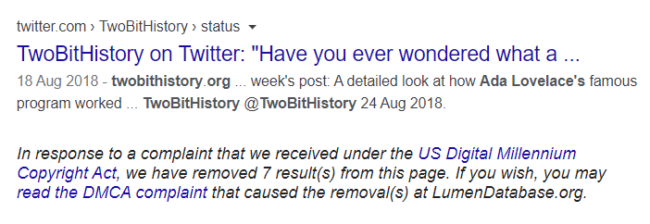
In 2018, the owner of Two-Bit History, a site dedicated to computer history, wrote a successful article about mathematician Ada Lovelace, who some credit as being the first computer programmer. Sadly, if you search Google for that article today you won't find it. Some idiotic anti-piracy company had it deleted because it dared to use the word "did." TorrentFreak reports: In 2018, [Sinclair Target, the owner of computing history blog, Two-Bit History] wrote an article about Ada Lovelace, the daughter of Lord Byron who some credit as being the world's first computer programmer, despite being born in 1815. Unfortunately, however, those who search for that article today using Google won't find it. As the image below shows, the original Tweet announcing the article is still present in Google's indexes but the article itself has been removed, thanks to a copyright infringement complaint that also claimed several other victims.

Sinclair's article was deleted because an anti-piracy company working on behalf of a TV company decided that since its title (What Did Ada Lovelace's Program Actually Do?) contained the word 'DID,' it must be illegal. This monumental screw-up was announced on Twitter by Sinclair himself, who complained that "Computers are stupid folks. Too bad Google has decided they are in charge." At risk of running counter to Sinclair's claim, in this case -- as Lovelace herself would've hopefully agreed -- it is people who are stupid, not computers. The proof for that can be found in the DMCA complaint sent to Google by RightsHero, an anti-piracy company working on behalf of Zee TV, an Indian pay-TV channel that airs Dance India Dance. Now in its seventh season, Dance India Dance is a dance competition reality show that is often referred to as DID. And now, of course, you can see where this is going. Because Target and at least 11 other sites dared to use the word in its original context, RightsHero flagged the pages as infringing and asked Google to deindex them.
In the complaint sent to Google, "the notice not only claims Target's article is infringing the copyrights of Dance India Dance (sorry, DID), but also no less than four online dictionaries explaining what the word 'did actually means," adds TorrentFreak. "Perhaps worse still, some of the other allegedly-infringing articles were published by some pretty serious information resources [including the U.S. Department of Education, Nature.com, and USGS Earthquake Hazards Program of the U.S. Geological Survey]."
Google

EU Judge Raises Prospect of Increasing Multibillion Fine Against Google (reuters.com) 86

Alphabet's appeal against a multibillion-dollar fine for alleged anticompetitive behavior by its Google unit risks backfiring after a European Union court floated the prospect of increasing the fine (Warning: source paywalled; alternative source), rather than scrapping it. The Wall Street Journal reports: In a surprise twist Friday at the end of a three-day hearing, one of five judges on the panel said the EU's General Court has the power to increase the $2.6 billion fine, levied in 2017, if it finds that the sum was insufficient to deter the company from further anticompetitive behavior. "The fine of ~$2.6 billion was described as eye-catching, but it is a small amount of cash in your hands," Judge Colm Mac Eochaidh said in court. "Did that level of fine deter you from repeating your behavior?" he asked Google's counsel. Increasing a fine has only one precedent in the court's history, according to Mr. Mac Eochaidh, when German chemicals giant BASF SE was ordered to pay ~$58,000 in 2007 on top of an initial ~$38 million fine for participating in a chemicals cartel.

Christopher Thomas, a counsel for Google, dismissed the idea that the fine was warranted and said the company takes the entire antitrust process "with extreme seriousness." Google disputes the findings of the commission that it had willingly or negligently squeezed competitors out of its shopping searches. The prospect of raising the fine was described as theoretical by the panel's presiding judge. Still, it sent Google lawyers scrambling for arguments, with one sitting on the floor outside the courtroom frantically researching how to contest such a move. If Google loses the case, it has the right to appeal to the bloc's highest court, the European Court of Justice.

The Courts

Apple Liable For Millions In Unpaid Wages After Court Rules Retail Worker Bag Checks Illegal (appleinsider.com) 117

The California Supreme Court in a decision (PDF) delivered on Thursday found Apple broke state law by not paying retail workers for the time they spent participating in mandatory bag and device searches, leaving the company liable for millions in unpaid wages. AppleInsider reports: In a unanimous ruling, the court holds employees were and are in Apple's control during mandatory exit searches of bags, packages, devices and other items. As such, Apple is required to compensate its employees for time spent on the anti-theft program, which in this case allegedly amounted to up to 20 minutes worth hundreds or thousands of dollars a year.

Chief Justice Tani Cantil-Sakauye notes courts should consider a number of factors when evaluating employer-controlled conduct, including location, degree of employer control, benefit to employees and disciplinary consequences. Applying the logic to the current case, "it is clear that plaintiffs are subject to Apple's control while awaiting, and during, Apple's exit searches. Apple's exit searches are required as a practical matter, occur at the workplace, involve a significant degree of control, are imposed primarily for Apple's benefit, and are enforced through threat of discipline," Cantil-Sakauye writes. Apple's policy demands hourly retail employees submit to a search of personal packages and bags at the end of each shift and when clocking out for meal breaks. The checks are performed off-the-clock, meaning workers do not get paid for the mandatory procedure.

Slashdot Top Deals